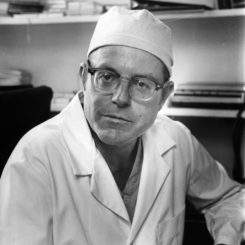
Doctor Richard Rowland Lower was a pioneer in the field of cardiothoracic surgery. He worked closely with his surgical and research partner Norman Shumway, discovered many surgical techniques that gave Prof. Chris Barnard the ability to conduct the first heart transplant. This includes the orthopedic technique, as well as hypothermia- which became the standard technique used in cardiac surgery.
Richard Lower was born in Detroit, Michigan, where he attended Amherst College. He went on to complete his medical degree at Cornell University in 1955. He was invited for a surgical residency in 1957, where he met his research and surgical partner, Norman Shumway.
The two worked together in a quite dark and leaky laboratory, where they honed many surgical techniques on dogs. The two surgeons were very successful, and in 1959, they managed to do a heart transplant on a mongrel, which survived 8 days after the transplant.
Thanks to this discovery, the two doctors ended up on the front page of the New York Times.
The two felt quite confident in their findings, and in 1960 published a paper that combined their surgical advances with improvements in recipient support and donor organ prevention.
This paper has been described as the “cardinal paper in Orthotopic cardiac transplantation.” The report stated that out of the 8 dogs who received the heart transplants, five survived past the 6-day mark. These deaths were reported to be as a result of Immune rejection.
Lower was recruited by the Medical College of Virginia. Here he continued working on his surgical techniques. In 1966, Chris Barnard visited the College, where he carefully observed the new found techniques. This set off the start of dog-experiments by Prof Barnard upon his return to South Africa.
In 1967, Chris Barnard achieved what Lower and Shumway tried perfecting for years- the first heart transplant. The pair was quite content with his achievement, even sending a letter of congratulations (which can be seen in the Heart of Cape Town Museum). Lower performed his first human heart transplant in May of 1968. Lower was sadly hit with a multi-million dollar lawsuit- from the family of the donor, who was pronounced brain dead due to severe head injuries.